
By Chloe Chan
Diffuse midline glioma (DMG) is a rare and devastating brain tumour that mostly affects children. Diffuse intrinsic pontine glioma (DIPG) is a form of DMG located in the pons of the brainstem. Approximately 25% of patients with DIPG carry mutations in ACVR1, the gene responsible for producing a protein called ALK2. Previous research has shown that inhibiting ALK2 in DIPG cells reduced tumour growth and, in mouse models, extended survival. Researchers have determined that this protein is a compelling drug target for DIPG and is of high interest for clinical translation (Carvalho et al., 2019; Pearson et al., 2025).
This gave M4K Pharma, operating under Agora's open science model, a clear mission: to discover a drug that works and can reach patients affordably. With this mission in mind, researchers set out to find a compound that could safely block ALK2 and slow tumour growth, a goal that would be extraordinarily difficult to achieve. This compound would have to simultaneously overcome many obstacles. It would have to block ALK2 selectively to avoid disrupting other important biological pathways, slow the growth of DIPG cancer cells, and cross the blood-brain barrier to reach the tumour. With a median survival of only 9-12 months, DIPG leaves children with a very limited treatment window, so the compound must be safe, well tolerated, and must not impact quality of life (Carvalho et al., 2019).
The Drug Discovery Process
M4K Pharma began with a lead compound that blocked ALK2 very effectively, but it had two major flaws. It inhibited many other targets, potentially causing unwanted side effects, and did not cross into the brain. To fix this, the team designed new compounds that kept the ability to block ALK2 while improving selectivity and brain penetration. Each round of compounds was tested and analyzed, and what the team learned shaped the design of the next round, improving the compounds’ properties with every cycle. In total, approximately 800 compounds were made and tested at the first stage. Each stage after that acted as a filter, so a compound had to meet certain criteria to advance, and those that didn't were not tested further. Many compounds were eliminated at the very first hurdle, and with each stage, the pool got smaller until only the most promising candidates were left.
Stage 1 involved potency and selectivity. Does the compound block ALK2, and does it do so selectively? A drug that interferes with other, unrelated proteins in the body is more likely to cause side effects, so selectivity was a major factor.
Stage 2 tested how the compounds affected cancer cell growth. Selected compounds were tested directly in DIPG cell lines, which were grown in the lab from tumour cells taken from real patients. Those that could slow the growth of these cells were moved to the next stage.
Stage 3 tested in vitro pharmacokinetics. Starting in the lab, researchers needed to predict how the body interacts with the drug. It must not break down too quickly, react badly with other enzymes, or interfere with normal heart function. A cardiac safety check, called hERG testing, determines whether a compound blocks potassium channels in heart cells. This channel helps keep the heartbeat steady, so blocking it can cause dangerous heart rhythm problems. Another test measures plasma protein binding (PPB), or how much of the drug remains unbound in plasma. Only a compound that remains unbound can reach its target, so a compound that binds too tightly would not be considered for the next stage. This stage also tests how the compound interacts with liver enzymes, which break down most medications. People with cancer often take several drugs at once; if a compound blocks the enzyme responsible for clearing another drug, that drug can build up to toxic levels. The chosen compound must not cause this kind of drug-drug interaction.
Stage 4 tested in vivo pharmacokinetics. Since DIPG tumours are located deep in the brainstem, compounds need to be tested on whether they are able to cross the blood-brain barrier (BBB). This is difficult because the BBB protects the central nervous system (CNS) and acts as a very selective filter, meaning it blocks out most foreign substances, including many drugs. Thus, a compound must have certain physicochemical properties to penetrate this barrier.
Stage 5 involved testing a compound's efficacy. The remaining compounds were tested in mouse models designed to closely mimic real DIPG tumors in terms of location and cell type. Human DIPG cells were implanted into the brainstems of immunodeficient mice, recreating the tumor in its natural location and allowing researchers to test whether each compound could slow DIPG proliferation in a living system.
Very few compounds made it through all five stages. A few came close, but failed for various reasons, including poor penetration of the BBB, safety concerns, and/or low efficacy. One compound, however, M4K2009, was able to make it through every stage of the testing pipeline to a sufficient level, becoming M4K Pharma’s lead development candidate.
Interestingly, M4K2009 was not the most potent candidate that was tested. Its IC50, the amount of drug needed to block ALK2’s activity by 50%, was 14 nanomolar (nM). A lower IC50 indicates greater potency,meaning potentially less drug may be needed to achieve the same effect. Several other compounds were more potent, with IC50 values as low as 2-3 nM, but those compounds fell short in other areas, such as brain penetration, safety, or efficacy, and were not selected. M4K2009 succeeded on multiple fronts at once: it blocked ALK2 with strong potency while remaining highly selective, it demonstrated the ability to cross the BBB, allowing it to reach the brain concentrations needed to have an effect. It also showed efficacy in mouse models that closely mimic how DIPG behaves in patients and passed various safety tests. Overall, M4K2009 had balanced potency, safety, brain penetration, and efficacy.
M4K2009's journey shows what it actually takes to bring a rare disease drug this far. It required a long, disciplined process of testing and refining various steps, guided by and based on real data and support from a cross functional team of experts. Reaching this stage is an important milestone, but this journey is far from over, as M4K2009 advances through the next stages of drug development towards clinical trials.
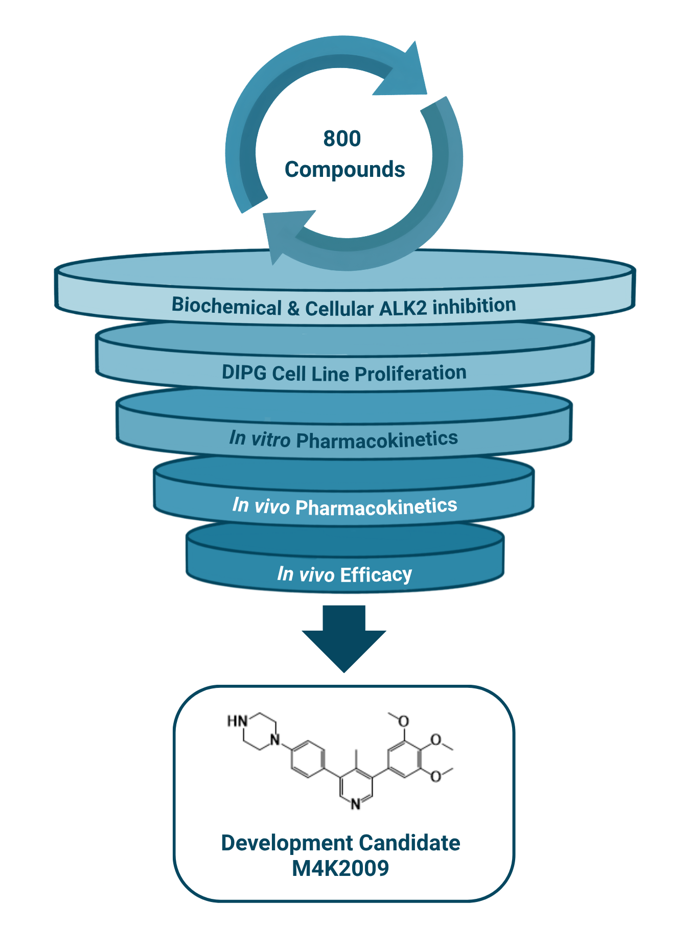
Our five stage process
References
Carvalho, D., Taylor, K. R., Olaciregui, N. G., Molinari, V., Clarke, M., Mackay, A., Ruddle, R., Henley, A., Valenti, M., Hayes, A., Brandon, A. D., Eccles, S. A., Raynaud, F., Boudhar, A., Monje, M., Popov, S., Moore, A. S., Mora, J., Cruz, O., … Jones, C. (2019). ALK2 inhibitors display beneficial effects in preclinical models of ACVR1 mutant diffuse intrinsic pontine glioma. Communications Biology, 2(1). https://doi.org/10.1038/s42003-019-0420-8
Pearson, A. D., Mueller, S., Filbin, M. G., Grill, J., Hawkins, C., Jones, C., Donoghue, M., Drezner, N., Weiner, S., Russo, M., Dun, M. D., Allen, J. E., Alonso, M., Benaim, E., Buenger, V., de Rojas, T., Desserich, K., Fox, E., Friend, J., … Vassal, G. (2025). Paediatric strategy forum for medicinal product development in diffuse midline gliomas in children and adolescents accelerate in collaboration with the European Medicines Agency with participation of the Food and Drug Administration. European Journal of Cancer, 217, 115230. https://doi.org/10.1016/j.ejca.2025.115230